Doors openingLoading the app. The first time takes a few seconds.

Setlist Tracker Open the app

A marathon training log that calls every run a Show.

Setlist Tracker is for people training for a marathon who run to music, on a treadmill or outside. It keeps the log and it writes the plan, from rules you can read. Your long run is the Headliner. Race day is Opening Night.

Open the app

Free, in your browser. No account needed.
iPhone app on the way.

The sample Tour on this page plays Opening Night on Mar 18, 2027. Yours counts down to your own race.

Week of Nov 16 40 mi

  1. Born to RunTue 17 · Easy · Live Show · 5 mi at 9:05 /mi
  2. LevitatingWed 18 · Tempo · Studio Session · 7 mi at 8:10 /mi
  3. Midnight CityThu 19 · Easy · Live Show · 5 mi at 9:00 /mi
  4. RunFri 20 · Easy · Live Show · 5 mi at 9:24 /mi
  5. Dog Days Are OverSat 21 · Recovery · Live Show · 3 mi at 10:00 /mi
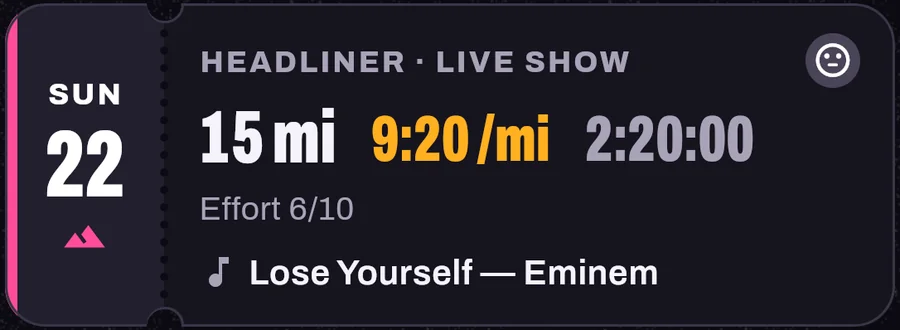
  6. Lose Yourself “the hill”Sun 22 · Headliner · Live Show · 15 mi at 9:20 /mi
Sunday’s run as the app shows it, a ticket stub: Sun 22, Headliner, Live Show, 15 mi, 9:20 a mile, 2:20:00, effort 6 out of 10, song Lose Yourself by Eminem.
One week from the app’s sample runs, written out as a setlist. Sunday’s stub is how the app prints it.

Liner notes

I’m Ryan. I built Setlist Tracker with Claude, and this page is the sleeve it comes in: what’s on the record, how the plan works, and what got left off on purpose.

The short version. A marathon takes months of training, and a lot of those months look like the same week with slightly bigger numbers. Calling it a Tour doesn’t make the miles any shorter. It does give each one a date, a name and a song, which is the whole idea.

The tour words aren’t decoration. Each one stands for a thing you already know from running, and the app uses them on every screen. Here are the nine you need first.

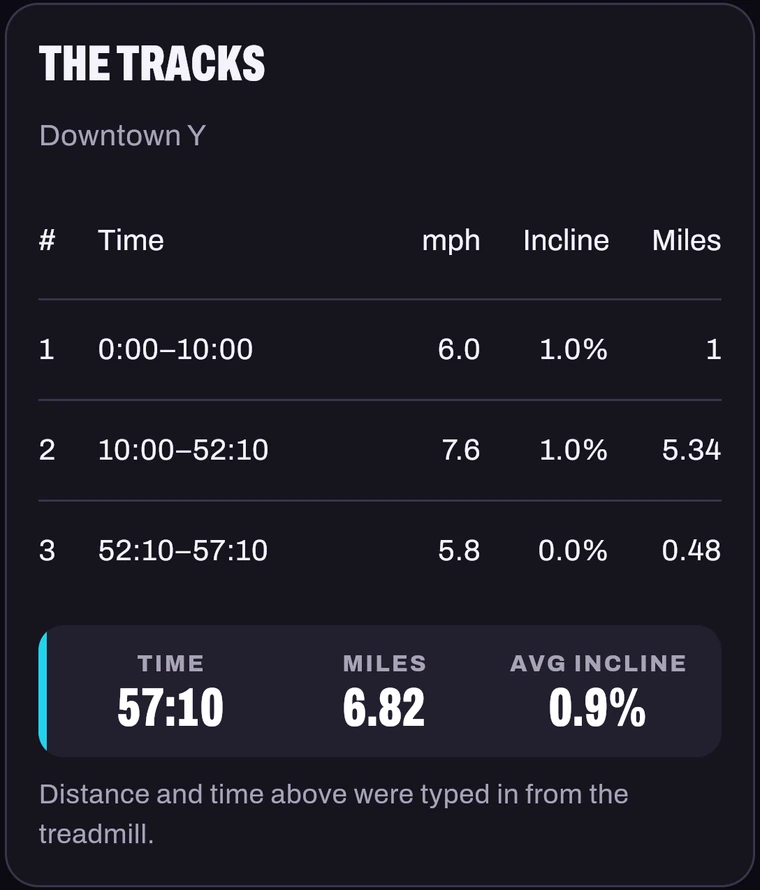
The Tracks table from a Studio Session at Downtown Y. Track 1: ten minutes at 6.0 mph, 1 percent incline. Track 2: 10:00 to 52:10 at 7.6 mph, 1 percent incline, 5.34 miles. Track 3: five minutes at 5.8 mph, flat. Totals 57:10, 6.82 miles.

Track 2 is the tempo: 42 minutes at 7.6 mph, 1% incline.

Tracks add up to 6.82. The treadmill said 7. You choose who’s right.

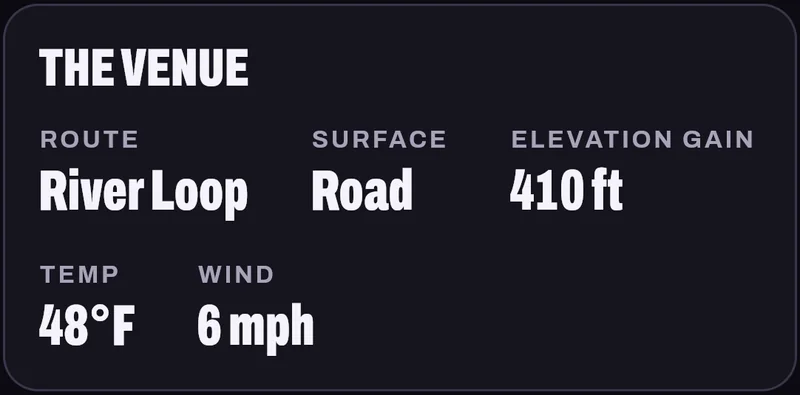
Outside, you type these instead: the route, the surface, the climb, the weather.

The treadmill gets a proper log

A1 to A4

A treadmill run usually goes in a log as one flat number. Here it’s a Studio Session, and you log it Track by Track: when each one started and ended, the speed in mph, the incline. The app multiplies it out, so you never type a distance or a pace.

When the belt and the arithmetic disagree, flip one switch and type what the treadmill screen said instead. You can name the gym and the treadmill too, for the days it matters that it was the wobbly one.

Save Tuesday’s intervals once, not every Tuesday. Keep the Tracks as a Saved Mix and load them next time in one tap. Editing a Mix later never rewrites an old Show.

Outside, it’s a Live Show: the route, whether it was road, trail or track, the feet you climbed, and the weather in °F and mph of wind. Either kind gets an effort from 1 to 10, the shoes you wore, and a verdict somewhere between Rough night and Encore!

It’s a log, not a recorder. There’s no GPS and no map. You run, then you write it down.

One song per Show

A5 and B3

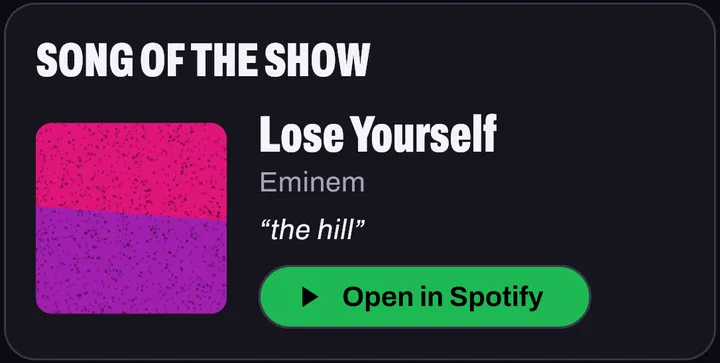
Every Show can carry one song. Search Spotify or Apple Music, or type it in when the search comes up empty. Then pick your part: 15 seconds of the 30-second preview, the bit that got you up the hill. It’s one tap away whenever you open that Show.

Sunday’s Headliner. The whole note: “the hill”.

There’s room for a note too. The app’s own example is mile 9 second wind, which is about the right length.

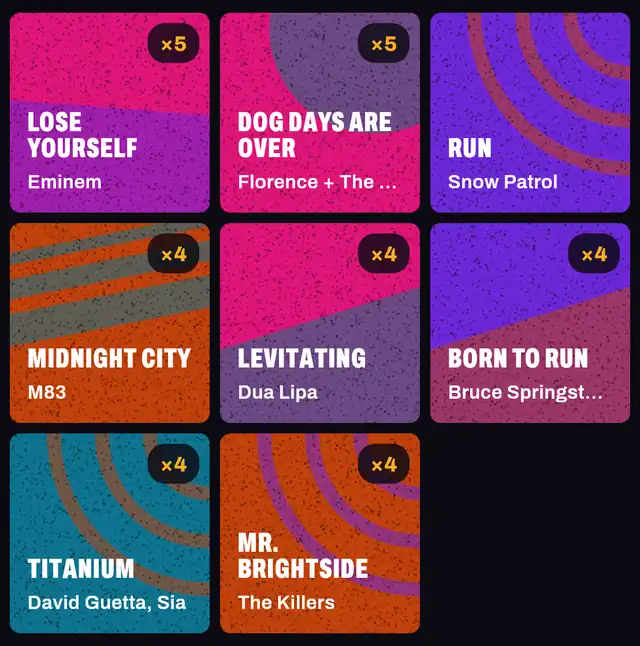
A few weeks in, you have a back catalog. The Record Wall is every Song of the Show with a count of the runs it carried, and your top five artists, ranked by Shows soundtracked and then by miles.

It doesn’t stream full songs and it won’t build you a playlist. It copies the track list, or hands you a CSV, and a playlist maker takes it from there.

×5 means five Shows, same song. The Wall doesn’t judge.

The plan is arithmetic. You can read every rule.

B1 and B2

The plan is called The Tour. Answer eight questions: the race date, your goal, the miles you run a week right now, your longest run this past month, any recent race, how many days you can run, which day is Headliner day, and treadmill or outside. The app books The Tour, up to 20 weeks, ending on Opening Night.

There’s no AI in it. It’s a short list of rules, the same ones every time, and I’d rather print them than ask you to trust them.

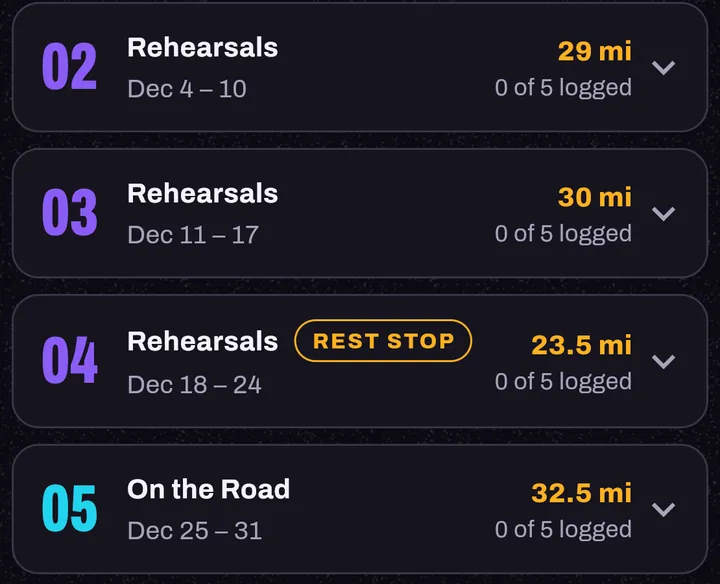
Tour Dates in the app. Week 2, Rehearsals, 29 miles. Week 3, 30 miles. Week 4, marked Rest Stop, 23.5 miles. Week 5, On the Road, 32.5 miles.

Week 4: 30 down to 23.5. About three quarters, on purpose.

10%
The most your weekly miles grow from one building week to the next. About the same step each time, never a jump.
Every 4th week
is a Rest Stop. Miles drop to about three quarters of the week before, the Headliner to about 70%, and there’s no hard run. Runs are rounded to the half mile, so a week lands near those numbers, not exactly on them.
  1. Rehearsalsweeks 1 to 4Easy miles to build the base
  2. On the Roadweeks 5 to 8Mileage climbs, tempo runs start
  3. Headline Legweeks 9 to 14Peak weeks and the longest Headliners
  4. Soundcheckweeks 15 and 16Taper: less volume, fresh legs

Both rules, drawn. The hollow bars are Rest Stops. The tall amber one is the peak week, with a 20 mile Headliner.

Weekly miles on the sample Tour in these screenshots: a 16-week Tour booked from 28 miles a week, with a 3:45 goal. The sample week at the top of the page was set up on its own, so the two don’t line up. The last bar is race week, shakeouts plus the 26.2. A worked example, not your plan. Yours comes out of your own eight answers.

The rest of the rules

  • The Headliner, your long run, grows by at most 2 miles in a building week. It tops out at 20 miles, or 18 if your goal is to finish or you start under 20 miles a week, 3 weeks before race week when the calendar allows.
  • One hard run a week once Rehearsals are over, if you run at least three days: a tempo while you’re On the Road, half-mile repeats in the Headline Leg. None in a Rest Stop.
  • 2 or 3 weeks of Soundcheck. Three on Tours of 18 weeks or more, two on shorter ones.
  • Paces come from a recent race, by Riegel’s formula: T2 = T1 × (D2 ÷ D1)1.06. No race? From your goal time, then from your usual easy pace. None of those, and you run the Tour by feel.
  • Planned Studio days arrive with the Tracks already written out: 1% incline, speeds to the nearest 0.1 mph.
  • Race week is two or three short shakeouts, then 26.2. The note on the day reads Start a touch slower than goal pace for the first 3 miles. Enjoy the show.

Then you miss a Tuesday, and the Tour Manager leaves a note

Miss a Show and it offers to move it to an open day this week. Three easy runs in a row that felt like an 8 or harder, and it offers a lighter week. Running well ahead of plan at low effort, and it offers faster paces, by 15 seconds a mile at most.

Every note has two buttons: one that says what it will do, like Move to Thu, Make it a Rest Stop or Update paces, and Not now. Nothing in your plan changes until you tap the first. And when a day goes exactly as written, one button, Done as planned, logs it for you, Tracks and all.

Under 16 weeks to race day, it still builds and tells you it’s a Short Tour. Under 12, it warns that the race may be too soon. Under six, it won’t build at all. The line the app always shows with the plan: General training guidance, not medical advice. If you are injured or have a health condition, check with a doctor or coach first.

The 11th is the marathon itself.

Eleven Gold Records, worked out fresh every time

B4

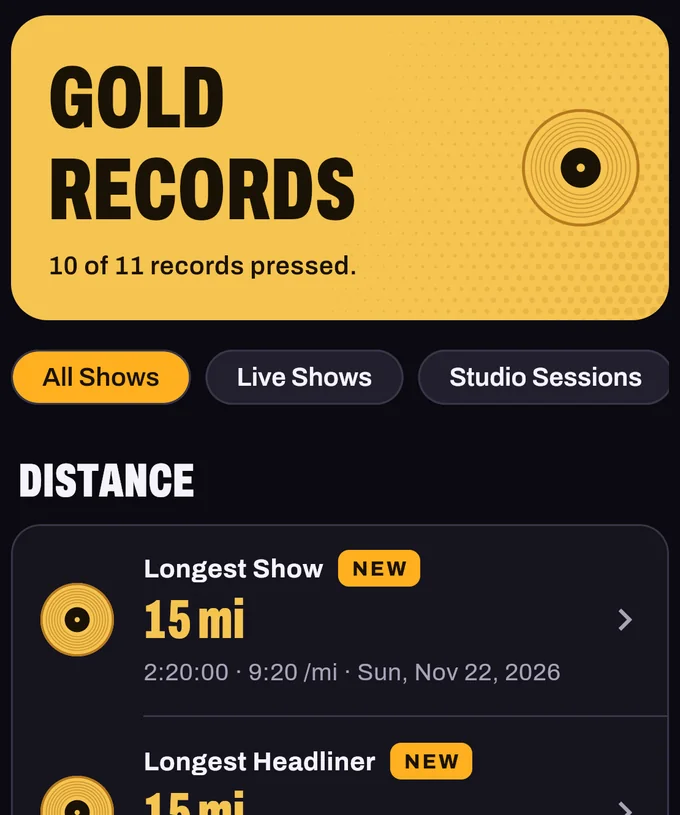
Longest Show, biggest week, fastest 10K, most climbing, steepest Studio Session and six more. None of them are stored: the app reads them off your log each time you look, so fixing a typo in an old Show can’t leave a wrong record hanging on the wall.

One footnote, because it’s true: the race-distance records use a Show’s average pace, not your fastest split. The app logs one distance and one time per Show, so that’s all it honestly knows.
The Crew: guest list only

B5

The Crew is for the two or three people who’d actually want to know you did 16 miles on Saturday. You invite them with a link or an 8-character code that works for 7 days, and they see the Shows you log, unless you keep one to yourself. No search, no public profile, no comments, no leaderboard.

Your Crew sees

  • Every Show you log
  • Miles, pace and time
  • Effort, feel and notes
  • Tracks, route and weather
  • Gear
  • Song of the Show
  • Gold Records and your Tour

That’s the point of a Crew: they see the week you actually ran, the wobbly ones too.

Stays with you

  • Any Show you mark Keep off the Crew

One switch on the Show. Flip it and only you see that one.

The only reaction is an Encore. The feed shows how many, never who. Every Show in the feed has Block and Report. The Crew needs a sign-in, called a Backstage Pass. Syncing between devices is the only other thing that does.

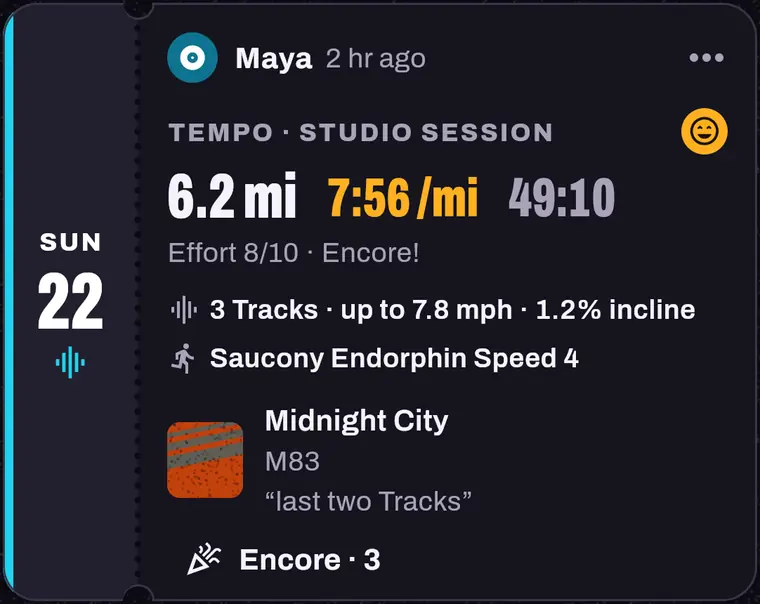
A shared Show in The Crew feed, from a sample Crew: Maya, 2 hours ago, a tempo Studio Session, 6.2 mi at 7:56 a mile in 49:10, effort 8 out of 10, 3 Tracks up to 7.8 mph at 1.2 percent incline, Saucony Endorphin Speed 4, song Midnight City by M83 with the note “last two Tracks”, and Encore 3.

Maya is sample data, the screen is real. 6.2 miles, three Encores, and nobody knows whose.

Credits

There’s no team page because there’s no team. One person made this, me, with Claude.

If you run a Tour with it, or it does something strange to your week, tell me. That’s the review section, for now.

Ryan

The small print, at a size you can read

Account
None needed. A Backstage Pass (Google or Apple sign-in) is only for syncing between devices and for The Crew.
Where your runs live
Without a pass, your runs stay in this browser and nowhere else. The one thing that leaves is a song search, which goes to Spotify (through the app’s server) and to Apple. The catch: clear your site data and your runs are gone.
With a pass
Stored on Cloudflare so your devices can sync. Delete account erases all of it, on every device, right away.
Ads, analytics, trackers
None. Your data is never sold or shared for marketing.
Price
Free to use.
Testimonials
None yet, and none made up.

Left off the record

  • GPS tracking
  • Heart rate
  • Strava import
  • An AI coach
  • Leaderboards
  • Notifications
  • Kilometers
  • 5K plans

None of these are in the app. If one of them is the thing you need, this isn’t that, and it would be rude to pretend.

Doors are open

It runs in your browser, on the phone in your hand or the laptop on your desk. Log one run. If it sticks, book The Tour.

Open the app

Free. No account needed.
iPhone app on the way.

No sign-up form. It just opens.